 |
|
 |
|
| Reviews of Asian Films | |
| Vital | |||||||
|
Does Tadanobu Asano being in a Japanese film mean, that it is a good film? I think it does – until you tell me of a bad film, he has been in lately (and he is almost everywhere these days).
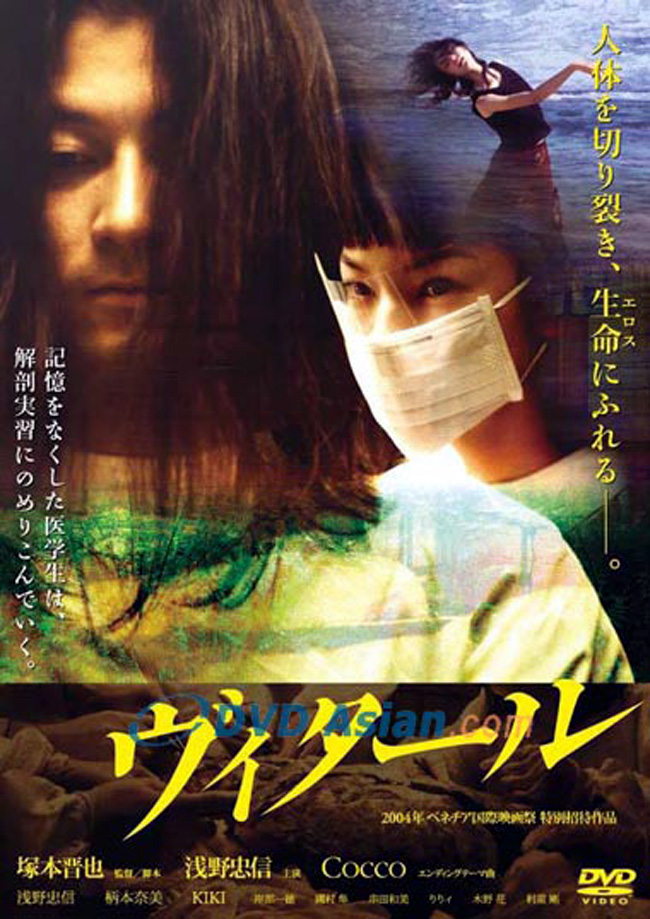
To me, Vital is more than a good film. Hiroshi Takagi (Tadanobu Asano) wakes up in a hospital bed with no memory. He cannot remember his father or mother – both sitting by the hospital bed. He speaks, writes, thinks and everything else, but he remembers nothing about himself or his family. His father tells him, he survived a car accident that was not his fault. Later, he tells him that his girlfriend Ryoko (Nami Tsukamoto) died in the accident. His parents (both doctors) take him home to recover, and hopefully regain his memory. He finds a box of medical books in his closet, and assumes he studied to become a doctor as well – so he enrolls in medical school. He soon becomes a top student, and another top student – beautiful Ikumi (Kiki) – becomes attracted to him. Soon she is obsessed with him, but he hardly notices. He barely speaks to anyone and seems like an empty shell. Then the students begin their first dissections, and everything changes. The corpse Hiroshi is dissecting is a young woman. A tattoo on her arm jogs his memory. Slowly it begins to return. The woman he is dissecting is Ryoko – his dead girlfriend! He starts having vivid dreams of her. Is he dreaming? Is he just fantasizing about her? Or has he found some strange way of communicating with her spirit? If director Shinya Tsukamoto is not the ultimate multitalent – well I don’t know who is. He has directed 11 films, he has been an actor in 26 films and his credits in Vital include: Director, Writer, Cinematographer, Producer, Editor and Production Designer – wow! Take the cinematography for instance. Should the cinematography in a Japanese film be less than excellent you begin to doubt, if the film is really Japanese! You have no doubts about Vital. Tsukamoto uses a lot of blue and red filters in the beginning to great effect. You see pictures of old stained walls and elevator doors, where the stains looks like Rorschach tests – especially as we see them through the eyes of Hiroshi Takagi and get the feeling, that these stains helps him focus. Later we see dead Ryoko dancing on the beach with staccato like movements full of rhythm and ballet grace – looking extremely alive. We see the cold scenes from the dissection room. Tsukamoto does not dwell on dead bodies being carved up, but keeps a distance – mostly we see the dissection through Hiroshi Takagi’s pencil drawings of the bones, muscles and brain tissue. Still, it may not be for the squeamish – you will hear some quite effective slurping sound effects as bones are being pulled lose. When the students are through with the dissection, we see a simple ceremony, where they honor the dead bodies. Does this happen in real life, in every dissection all over the world? I think not. It should, though. A beautiful scene. Vital does not give answers as much as asking questions. What is a person without memory? Are there spirits, and can you communicate with them? Is it just a fantasy – but a fantasy that helps you to get well? You should find your own answers, but the beauty and mood of Vital should at least start you thinking – and that’s a good first step. |
|||||||
|
Uffe Stegmann
July 31, 2005 |
|||||||
|
GALLERY
|


 |
|||||||||||||||||||||
 |
|||||||||||||||||||||
|
|
|
|||||||||||||||||||

